Romanov sheep – Imperial sheep originated in Russia in the middle of the 19th century in the valley of the Volga River in the Yaroslavl region.It got its name from the Romanovsko-Borisogleb district, which is located near the present-day town of Tutajevo.From the very beginning, strict selection was made according to fertility, and the consequence of that selection work is the most fertile breed of sheep in the world.
Fertility
The average fertility of Romanov sheep is about 250% per lamb (while with excellent nutrition it is over 400%), which would mean that 100 sheep give 250 to 400 lambs in one lambing.These sheep also have a pronounced polycyclic nature, which means that with proper nutrition, lambing can be achieved naturally in just six months.In one year, when a lamb is born every 6 months, one ewe gives an average of four to six lambs, which is a number that no other breed can give.In this way, from one herd we get from 120 to 170 kg live weight lambs if we take into account that the average weight of lambs is about 30 kg.That amount of lamb meat per ewe cannot be naturally produced by any other breed for the same lambing period.
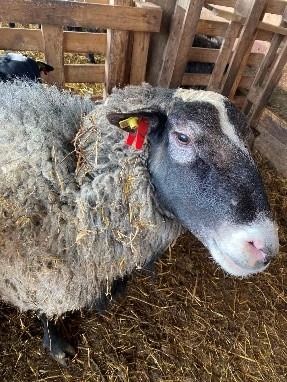
Rams have a mane of long black spiky fibers around the neck and on the front of the chest.The yield of wool per ewe is 1.4 – 1.6 kg, and for rams 2 – 3 kg.The legs, face and ears of animals of this breed are covered with short black hair, and partly with white because of the patterns that appear.The ability to produce milk is quite well expressed in sheep of this breed.
Dimensions
This sheep has smaller dimensions (50 to 60 kg) and therefore consumes less feed than sheep weighing 70 to 100 kg.The throats of this breed are very resistant, with no special requirements for food and housing.This sheep has a smaller build.Sheep weigh from 50 to 60 kg, and ours from 70 kg to 80 kg, while rams weigh from 70 to 90 kg, and our rams from 100 kg to 120 kg, and elite heads over 100 kg.They have a small angular head with a rounded skull and a short mouth as well as a tail that is 10 to 15 cm long.The height of the withers of sheep is from 60 to 62 cm, and that of rams is about 64 or 65 cm.They have a very stable constitution, short legs and very small bones, which makes them easy to lamb.Also, immediately after lambing, newborn lambs are very vital and start eating already at 5 to 7 days, which is much earlier than lambs of other breeds.Lambs are born with completely black wool with permissible white markings on the head, legs and tip of the tail.White patterns on the body except for the specified parts of the body are not allowed.The average weight of lambs at 100 days is 25-30 kg with adequate nutrition.The best specimens reach a weight of over 40 kg in 100 days.The wool is coarse, has a gray color, due to the mixture of fine, white fibers.It is also full of black wasp fibers.
Mating and sexual maturation
Sheep are mated 30 days after lambing, which makes them unique in the world, while e.g.other breeds need at least 42 days.Romanov sheep have a slightly shorter pregnancy period of 138 to 143 days, all of which affects the fact that sheep of this breed and their descendants have a lamb every 6 months.Sheep of this breed reach sexual maturity very early.Young throats are sexually mature in 4-5 months.Female sheep are generally allowed to mate at eight months, so that the first lamb is born at the age of one year, and already at the first lambing, the average fertility is about two lambs per ewe.
Milk
In sheep of this breed, the ability to produce milk of excellent quality is quite well expressed.With an average milk production of 150 to 200 liters per lactation, this ewe has no problem feeding its litter, which sometimes numbers 5 to 6 lambs.In a lactation period of 100 days, sheep produce an average of 100 to 150 liters of milk, and record sheep produce 200 liters of milk or even more.Due to high fertility, relatively good milk production and great vitality, sheep of this breed were imported to different parts of the Balkan countries, for crossbreeding with domestic breeds of sheep, where different results were achieved.
...but breed standards in Romanov sheep are shifting rapidly on our farm... so, here is the section of:
The latest news
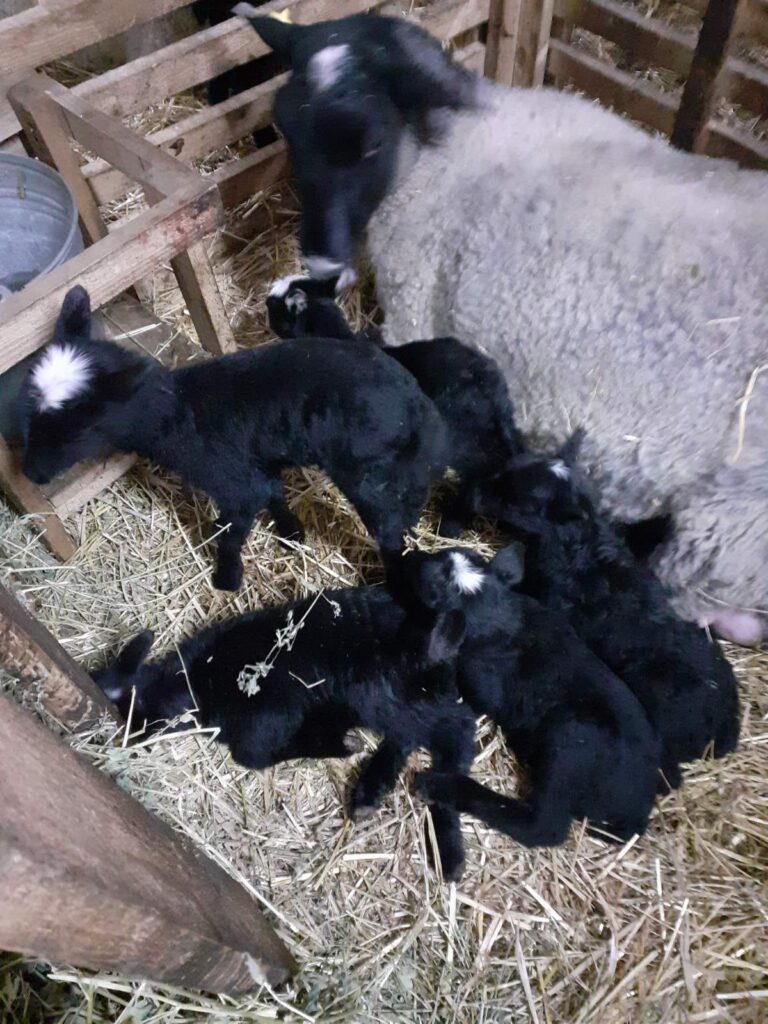
(23rd February 2026) Lamb birth weight increases with proper pre-lambing feeding, and that is clear. However, the total litter weight in the new lambing season (2026) with the new genetic lines is significantly higher. We set a new record for total litter weight in February 2026, when one sheep with 5 born lambs weighed 19.6 kg (see pictures). You should probably add another 10-15 liters of amniotic fluid (total 30-35 kg). So, this sheep lost 30-40% of its weight by completing parturition.
This genetic influence is evident in ewe-lambs (first-lambing sheep). In the 2022-2025 season, with a standard average of 3.3 lambs (3 alive), they had lambs weighing 2.5-2.9 kg, and now, the new generation of first lambs of ewe-lambs is predominantly giving birth with individual weights between 3.0-3.6 kg (weighing 0.5-0.7 kg more).
It is certainly desirable to have heavier Romanov lambs for a good start (what is obvious for them), but whether it is good for the mother will soon be seen… or this parameter will have to be returned to a lower birth weight and balanced with the semen of older generations of rams. Too big lambs will endanger a needed space in the womb for those that are lambing more than 4 lambs. We have some lambs now with bent pedicles in litters with 5 lambs (due to lack of space; it’s a problem for a few days, but it’s not necessary for us).